

SQL-based cloud tests read table data, so they need data access for the environment’s warehouse connection. Data access is enabled in one of two ways:
- Elementary enables data access on the warehouse connection. Contact the Elementary team to turn it on.
- You connect an Elementary Runtime to the warehouse connection.
How it works
On each run, Elementary returns every row of the tested table whose value has no equal value in the target table’s target field. Each failing row is one row of the tested table, and the row sample contains the full rows.- Null source values are ignored. A row with a null value in the tested field never fails. To require a value, add a completeness test.
- The
whereclause applies to the tested table only. All rows of the target table are used as valid values. - Both tables must use the same warehouse connection, and the target table must be an asset in the Elementary Catalog.
Configuration
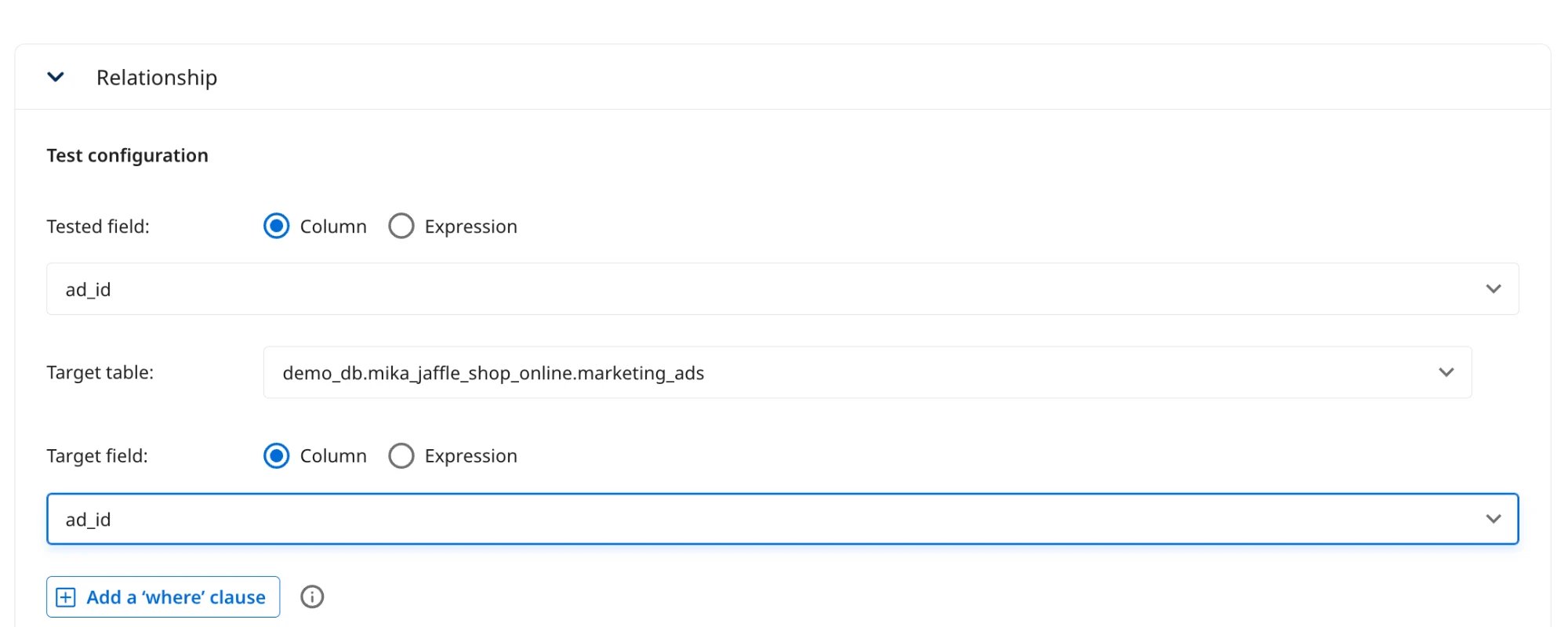
Relationship test configuration
Examples
dbt equivalent
The dbtrelationships test checks the same rule from your dbt project. See Cloud tests or dbt tests to decide which to use.